Law offices of Sabrina Li’'s Analysis of Policy Memorandum PM-602-0199: What the Memo Actually Does, Who Is Protected, and What I-485 Applicants Should Do Now
___________________________________________________________________________________________________________________________
Over the past week, headlines have suggested that USCIS Policy Memorandum PM-602-0199 — issued May 21, 2026 — effectively requires green card applicants to leave the United States and consular-process abroad. That is not what the memo says, and it is not how it is being applied.
What the memo actually does is reframe how USCIS exercises discretion under INA § 245. In-country adjustment of status, long the default pathway for eligible applicants already in the United States, is now treated as "extraordinary" discretionary relief, with consular processing abroad framed as the "ordinary" path. Within days of issuance, USCIS field offices were applying the new framework through expanded interview questions, requests for evidence on positive equities, and — in some offices — temporary holds on I-485 adjudications pending internal guidance.
Importantly, the memo does not bar anyone from adjusting who was eligible to adjust before. Several adjustment pathways are excluded from the memo outright. Others are protected by statute. And USCIS itself has indicated that many cases — including most H-1B and other lawful nonimmigrant filings — will continue on their current path.
That said, PM-602-0199 is the most significant change to adjustment of status practice in decades. It raises the bar most sharply for applicants with prior overstay or status violations, and it requires every applicant to put forward a stronger affirmative record than was previously needed. The sections that follow sort out who is affected, who is not, where the memo is legally vulnerable, what USCIS is doing in the first week of implementation, and what applicants should do now.
Key Takeaways
- Effective: Immediately, upon issuance on May 21, 2026.
- Applies to: All pending and future Form I-485 adjustment of status applications.
- Does NOT change: Statutory eligibility for adjustment under INA § 245. Immediate-relative carve-outs remain intact.
- What it changes: Officers must now affirmatively find that the applicant deserves a favorable exercise of discretion. Eligibility is necessary but no longer sufficient.
- Procedural safeguard: Discretionary denials must be in writing, identifying positive and negative factors and explaining the balance.
Who is NOT subject to the memo
Much of the public coverage has missed this. The memo applies only to discretionary § 245 adjustment. Refugees and asylees (§ 209), NACARA, HRIFA, and LRIF beneficiaries, Special Immigrant Juveniles, § 245(i) grandfathered applicants, T- and U-visa adjusters, and VAWA self-petitioners are either fully excluded from the memo or materially protected by statute. If your case falls in one of these categories, the memo either does not apply to you or applies in a sharply limited form — Section 5 sorts these populations in detail.
Section 245 of the INA says adjustment of status "may" be granted to eligible noncitizens — and the word "may," the courts have long held, means discretion. For decades, that discretion functioned as a safety valve: eligible applicants with clean cases were routinely approved.
PM-602-0199 changes the default. Citing Supreme Court and BIA authority, the memo instructs officers to treat in-country adjustment as "extraordinary" relief — an act of "administrative grace" — and to treat consular processing abroad as the "ordinary" path. Every I-485 must now clear two steps:
The applicant must meet every statutory requirement: inspected and admitted or paroled, an immigrant visa immediately available, admissible to the United States. This step is unchanged.
This is where the memo materially raises the bar. Wherever consular processing is available to the applicant — which is most § 245(a) cases — the memo treats the very choice of in-country adjustment as adverse. Drawing on Matter of Blas, the memo instructs that this adverse factor must be offset "by a showing of unusual or even outstanding equities," and that the absence of negative factors does not, by itself, establish those equities.
The shift is structural. Under prior practice, step two was a balancing test in which clean cases were routinely approved. Under the memo, the applicant must affirmatively demonstrate strong equities — with the choice of AOS itself counted against them. The memo applies this framework across the board: even applicants who maintained valid dual-intent status (H-1B, L-1) throughout are not exempt, because the memo expressly states that valid dual-intent status, on its own, is not sufficient to warrant favorable discretion.
Short answer: no, not really. The two-step framework the memo invokes — eligibility plus discretion — is well-established and uncontroversial. What is new is the policy gloss laid on top of it: that adjustment under § 245 is “extraordinary” relief the agency should be reluctant to grant, and that consular processing abroad is the “ordinary” path. That gloss is a significant departure from how Congress, the courts, legacy INS, and DHS itself have understood and administered § 245 since 1952 — a period during which Congress has repeatedly expanded the in-country pathway rather than constrain it. The memo does not address those Congressional expansions. In our view, the memo is ripe for litigation. We see three significant legal vulnerabilities.
Section 245 was enacted to allow eligible noncitizens to obtain permanent residence without leaving the United States. Congress has repeatedly expanded that pathway, most notably through § 245(i), § 245(k), and the immediate-relative carve-outs in § 245(c). Recasting the statutory mechanism Congress built as “extraordinary” is in tension with both the statute’s text and Congress’s evident intent. Discretion under § 245 is real, but the memo treats the entire in-country pathway as the exception rather than the discretion as the safety valve.
This is the sharpest point of the legal tension. INA § 245(c) bars certain applicants from adjustment, but Congress carved out immediate relatives of U.S. citizens from the most important bars — specifically the bars for unlawful status and unauthorized employment. The carve-outs are explicit and deliberate. They are how a U.S. citizen’s spouse who overstayed a visa or worked without authorization is still permitted, by Congress, to adjust status in the United States.
The memo cannot override those statutory eligibility rules, and it does not purport to. What it does is recharacterize the same conduct — overstay, unauthorized employment — as adverse discretionary factors at step two. If applied aggressively, the result is that USCIS may use discretion to claw back what Congress granted at the eligibility stage. That tension is, in our view, the strongest pressure point in the entire policy.
Two further concerns: first, the memo was not issued through notice-and-comment rulemaking. USCIS positions it as an interpretive rule, but it materially changes the operative standard for an entire class of benefits applications and imposes new evidentiary expectations. Plaintiffs in any future challenge will argue it should have gone through 5 U.S.C. § 553. Second, a sudden agency-wide reversal of decades of practice — where the same statute and case law previously produced routine in-country adjustments — may also be vulnerable to challenge as arbitrary and capricious, particularly given the reliance interests of millions of nonimmigrants who built lives in the U.S. on the expectation that adjustment would proceed normally if they remained eligible.
Where this leaves us
The memo is legally vulnerable, but vulnerability is not the same as invalidity. Until a court enjoins or vacates it, PM-602-0199 governs adjudications. Litigation challenges are likely, but applicants must operate as if the memo is the rule today — because, for purposes of the officer reviewing your file this week, it is.
After an aggressively worded press release accompanied the memo, the agency softened its tone over the weekend. A USCIS spokesperson told Newsweek on Sunday, May 24, that applicants whose cases “provide an economic benefit or otherwise are in the national interest” will “likely be able to continue on their current path,” while others “may be asked to apply abroad depending on individualized circumstances.” The Department of Homeland Security separately indicated to Semafor that existing H-1B holders would largely be unaffected in the near term.
Read carefully: “likely” is not “will.” “Largely” is not “entirely.” The clarification narrows the political exposure of the rollout but does not amend the memo. The discretionary framework still applies, and the agency retains the right to apply it case by case. Even applicants the agency now signals as low-risk should treat their cases as fully governed by the new standard — because, in adjudication, they are.
Immigration attorneys across the country are reporting consistent patterns within days of issuance:
The memo applies to most I-485 applications. But its bite is uneven. The table below reflects our current view of where the risk concentrates.
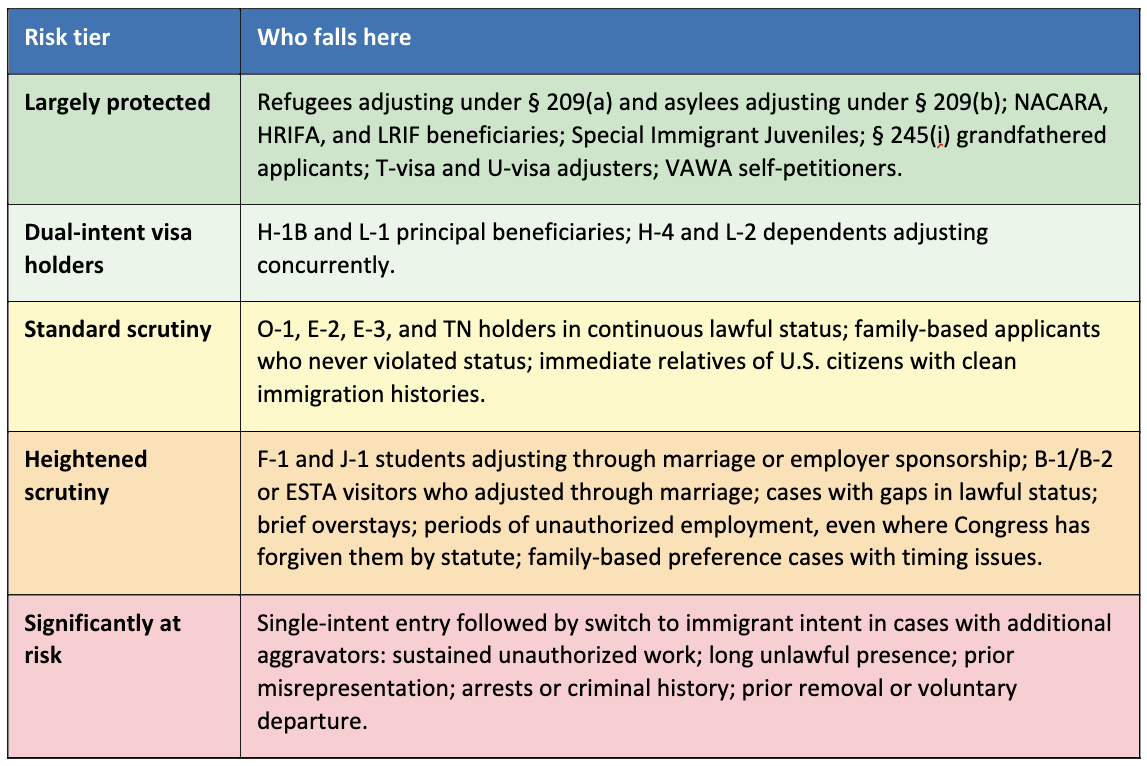
Not sure which tier your case falls in?
PM-602-0199 turns on facts — entry type, status history, length of residence, family ties, prior filings — and small differences in those facts can move a case from one tier to another. The Law Offices of Sabrina Li offer a confidential case assessment that places your I-485 within the framework above, identifies the equities the new memo will require you to document, and tells you honestly whether adjustment of status or consular processing with a waiver is the better forum for your case. Reach out by phone, email, or through our website to schedule.
These cases require immediate, individualized review. Options include comprehensive RFE or NOID response with a full discretionary record, motion to reopen or reconsider, renewal of adjustment in removal proceedings if applicable, federal court review where available, and, in some cases, strategic withdrawal of the I-485 and reinitiation through consular processing.
PM-602-0199 is not a reason to panic. It is a reason to file smarter, prepare more thoroughly, and bring the discretionary record forward to the front of the case rather than wait for it to be demanded. The Law Offices of Sabrina Li have already adapted our standard playbook to the new framework. Here is what that work looks like:
For the majority of our clients, the path forward under PM-602-0199 remains adjustment of status — filed strategically and supported by a strong discretionary record. What it means to “file strong” is changing materially under the new framework, and the story you present in the record now matters more than ever.
If you have a pending I-485, are planning to file one, or have already received an RFE or denial that appears tied to the new memo, contact the Law Offices of Sabrina Li. Every case is individual; under PM-602-0199, every detail of the record matters.
Contact us
Schedule a consultation. If you are filing, pending, or facing an RFE or denial under the new framework, the Law Offices of Sabrina Li can help you assess your case, build the discretionary record, and choose the right forum. Reach out through our website, by phone, or by email — every consultation is confidential.
Disclaimer: This article is for general informational purposes only and does not constitute legal advice. Immigration outcomes depend on the specific facts of each case and on policy and adjudication trends that are still developing. For case-specific guidance under PM-602-0199, please consult a licensed U.S. immigration attorney.
(213) 375-8096 (English)
(626) 800-4820 (中文)
(214) 584-6147 (Español)
Email
csteam@sabrinali.law
Office Hours
Monday - Friday
9:00 AM - 5:00 PM
Excluding public holidays
Add us on WeChat to connect with our team.